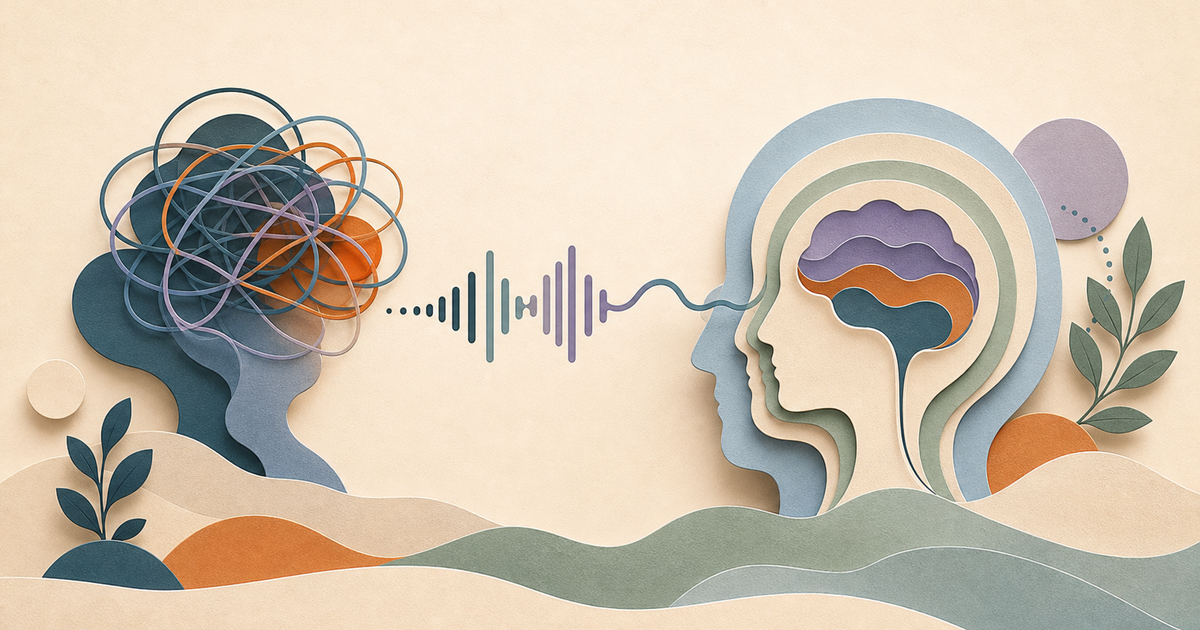
Why Speaking Aloud Can Help You Remember What You Read
Reading aloud and hearing your own voice can help words stick. Here's what a memory experiment found, and how to try speaking as part of studying.
You’ve read the chapter three times. You’ve highlighted the important parts. You feel prepared. Then the exam comes and your mind goes blank.
This happens because reading is one of the weakest ways to learn. Your brain processes passive reading on autopilot, skimming without encoding. But when you speak information out loud, everything changes.
The Production Effect: Why Speaking Creates Stronger Memories
Memory researchers call the advantage of saying words aloud over reading them silently the production effect.
In Forrin and MacLeod’s word-memory experiment, participants studied words in four ways: reading aloud, hearing their own previously recorded voice, hearing someone else, and reading silently. Recognition performance followed that order, with reading aloud highest.
The authors suggest that speaking combines a motor act with the distinctive experience of hearing yourself. The experiment measured recognition of words, not exam performance or understanding an entire chapter. It gives us a specific reason to try reading key terms aloud, rather than a universal promise about retention.
The Problem With Passive Learning
Most study methods are passive. Re-reading notes. Highlighting textbooks. Watching lecture recordings. Reviewing flashcards visually. These feel productive because you’re spending time with the material. But research on cognitive processing consistently shows passive review creates a dangerous illusion of knowledge.
You recognize the information when you see it. But recognition isn’t recall. Exams, presentations, and real-world application require recall, pulling information from memory without prompts.
The gap between “I’ve seen this before” and “I can explain this” is enormous. And passive studying rarely bridges it.
Speaking Engages Active Recall Naturally
When you explain something out loud, you immediately discover what you actually know versus what you think you know. Try it right now: pick any concept from your field and explain it aloud as if teaching someone.
Notice the gaps? The places where you stumble or reach for words? Those gaps are invisible during passive reading. They only surface when you produce the information actively.
This is why the science of speaking your thoughts has such powerful implications for learning. Speaking forces active retrieval and immediately reveals knowledge gaps you can then fill.
The Teaching Effect
Research on the “protege effect” shows that people who prepare to teach material learn it more deeply than those who prepare to be tested on it. You don’t even need an actual student. Explaining concepts out loud to an empty room produces the same benefits.
When you teach, you:
- Organize information into logical sequences
- Simplify complex ideas into plain language
- Connect concepts to examples and analogies
- Identify gaps where your understanding breaks down
All of this happens naturally when you speak. It requires deliberate effort when you write.
Voice + Listening: Review Your Explanation
You can record yourself and listen back to inspect an explanation. The experiment above compared speaking and listening separately; it did not test whether combining them multiplies the benefit. Use this routine as a practical way to check your work:
First pass (recording): Explain the concept without looking at your notes. Mark the places where you hesitate or cannot explain a step.
Second pass (listening): Compare your explanation with the source. Correct errors before using the recording for review; a confident explanation can still be wrong.
Third pass (re-explaining): Return later and explain the concept again from memory. Check accuracy, not just how smoothly you speak.
This is fundamentally different from re-reading highlighted notes. You’re actively producing, reviewing, and refining your understanding through voice.
Why Voice Matches How Your Brain Naturally Processes
Humans have been learning through spoken language for roughly 100,000 years. We’ve been reading for about 5,000. Your brain is optimized for auditory learning and verbal exchange in ways that text-based learning can’t fully replicate.
The lost art of verbal processing traces this back to oral traditions where entire histories, legal codes, and scientific knowledge were transmitted through speech. The human brain developed sophisticated auditory memory systems long before written language existed.
This doesn’t mean reading is useless. It means your brain has dedicated, deeply evolved pathways for processing spoken information that most study methods completely ignore.
Practical Applications
Studying for Exams
Instead of re-reading your notes for the fourth time:
- Close your notes and explain the key concepts out loud
- Check your notes for what you missed or got wrong
- Re-explain the gaps until you can speak the full concept fluently
- Record your explanation and listen to it later as review
This takes the same amount of time as passive re-reading but produces dramatically better retention.
Learning New Skills at Work
When you learn a new process, tool, or concept at work:
- Explain it aloud right after learning it, even to yourself
- Record a voice note summarizing the key points in your own words
- Listen back the next day before you need to apply it
This works for everything from software training to understanding new company policies.
Processing Complex Reading
After finishing a difficult article, book chapter, or research paper:
- Summarize the main argument out loud in 60 seconds
- Identify what surprised you and explain why
- Connect it to something you already know
Voice processing captures nuance that bullet-point notes miss. Your verbal summary naturally includes emphasis, connections, and reactions that reveal your real understanding.
Language Learning
Speaking a new language aloud, even to yourself, activates the motor memory pathways needed for fluency. Silent reading of vocabulary lists builds recognition. Speaking builds production. And production is what you need in actual conversation.
When Reading Works Better
Speaking isn’t always superior. Reading works well for:
- Initial exposure to brand new concepts where you need to go slowly
- Reference material you need to look up, not memorize
- Detailed technical specifications where precision matters more than recall
- Skimming for relevance before deciding what deserves deeper learning
The ideal approach combines both: read to understand, then speak to learn. Reading is intake. Speaking is encoding.
The Bottom Line
Your brain remembers what it produces, not what it passively consumes. Speaking your thoughts creates stronger neural pathways than any amount of re-reading, highlighting, or note-reviewing.
The next time you need to learn something that matters, close the textbook and start talking. Explain it like you’re teaching a friend. Record it and listen back tomorrow. Notice the gaps and fill them.
You don’t need better notes. You don’t need more study time. You need to hear yourself think.
Questions people ask
Does speaking out loud help you remember things better?
In a word-memory experiment, reading aloud produced better recognition than reading silently. Hearing a recording of your own voice also outperformed hearing someone else. These were separate conditions, not a test of a combined record-and-replay study routine.
Why is reading not the best way to study?
Reading is useful for understanding new material, but familiarity with a page does not show whether you can recall it. Close the text and explain the idea, then check what you missed. You can do that aloud or in writing.
What is the production effect in memory research?
The production effect is a well-documented memory phenomenon where information that is spoken aloud is remembered better than information that is read silently. The act of producing speech creates a distinctive memory trace that's easier to retrieve later.
How can I use voice to study more effectively?
Close your notes and explain a concept, then reopen them to check for mistakes and missing details. A recording can help you review your explanation. Revisit the concept later and try recalling it again rather than only replaying the audio.