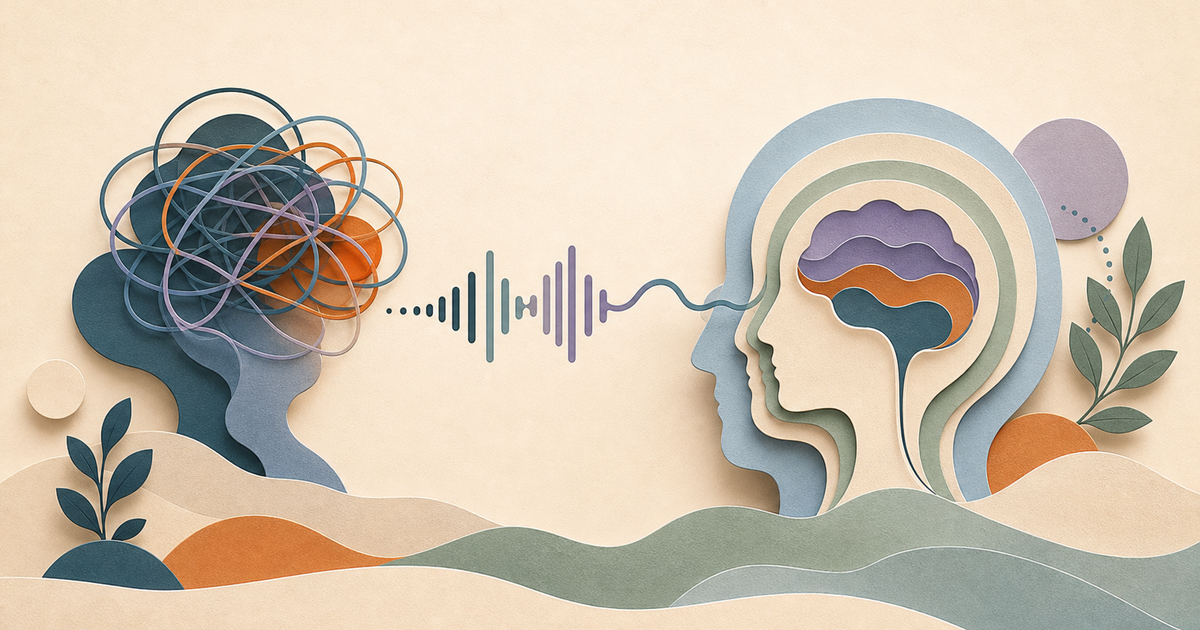
Why Speaking Out Loud Helps You Think
Why explaining a problem aloud can help you solve it, what speaking does for memory, and how to use both when your thoughts feel tangled.

You can rehearse a decision for an hour and still struggle to explain it in a sentence. Speaking gives you a chance to hear the missing connection: “I want to say yes because…” Sometimes the useful part is noticing that you haven’t finished the because.
Research gives us several reasons this can help, including self-explanation, memory for spoken words, and psychological distance. Each comes from a different kind of experiment. Here’s what those findings offer when you want to talk through your thoughts.
What Happens in Your Brain When You Speak Thoughts
Multi-System Neural Activation
Speaking involves coordinating movement with what you hear and feel. Research on speech motor control describes motor and premotor regions working with the cerebellum and auditory and somatosensory feedback systems.
That helps explain how you produce and monitor speech. More brain activity by itself doesn’t establish better reasoning; to understand the benefits for thinking, we need experiments that measure memory, learning, or performance.
The Production Effect
In eight experiments published in 2010, Colin MacLeod and colleagues studied the production effect: saying selected words aloud during study improved recognition compared with reading words silently. An important condition was mixing spoken and silently read words within a study list.
The authors connected this benefit to distinctiveness. The spoken items had something that helped distinguish them at the later memory test. Some experiments also found benefits from mouthing words.
This supports a specific use of speech for remembering selected information. It doesn’t give us a universal percentage for how much better you’ll remember a conversation, a decision, or an entire journal entry.
Working Memory Extension
Repeating something can help you keep it in mind, but saying it doesn’t move it into an unlimited external memory. A saved recording or transcript gives you a record you can return to without remembering every detail. That’s the useful distinction when you’re organizing scattered thoughts: capture the options, then review them one at a time.
Vygotsky’s Private Speech Theory
Vygotsky proposed that speech used in social interaction develops into self-directed speech and, eventually, inner speech. Children talking themselves through a task are an example of what researchers call private speech.
A review by Ben Alderson-Day and Charles Fernyhough examines this developmental account alongside research on memory and self-regulation. It also describes useful functions of silent inner speech. The theory doesn’t establish that adults lose effectiveness whenever they stop speaking audibly.
If saying the next step aloud helps you follow a complicated task, use it. If you prefer silent rehearsal, you aren’t giving up the ability to think with language. Our inner voice vs. outer voice guide explores the difference.
Self-Distancing: A Different Way to Refer to Yourself
When a friend describes a difficult decision, you can often ask a useful question without getting caught in every detail. You can try a similar perspective on your own situation.
In Ethan Kross and colleagues’ 2014 research, using one’s own name and non-first-person pronouns during introspection supported self-distancing and regulation under social stress. The research concerns how people refer to themselves, not proof that speaking aloud is always better than silent reflection.
For example, instead of repeating “I can’t handle this conversation,” try “What does Alex need to explain in this conversation?” Use your own name. Then answer the question with something concrete: a boundary, a request, or a fact the other person needs.
Our self-talk examples offer more ways to put that into everyday language.
Verbalization and Problem-Solving
The Articulation Advantage
Consider the difference between “I’m looking at the two offers” and “I’m leaning toward this offer because the work interests me, but I’m assuming the hours will be manageable.” The second version gives you an assumption to check.
A 2011 meta-analysis of 94 studies found that simply reporting thoughts aloud did not reliably change accuracy compared with silent performance. Instructions to describe or explain thoughts and actions, however, led to better performance. Verbal reporting also tended to take longer.
That distinction is useful. Give yourself room to explain a reason, rather than racing to produce more words.
Making Implicit Knowledge Explicit
A separate 2018 meta-analysis of self-explanation combined 69 effect sizes from 64 research reports. Prompting learners to explain connections and reasoning improved learning outcomes on average. These were learning tasks, not a test of voice journaling against writing.
Try this: Choose one conclusion you’ve been repeating and finish, “I think that because…” Then ask, “Which part do I know, and which part am I assuming?” You can do this aloud, on paper, or with a recording.
The Speed Factor: Matching Thought Pace
A 2016 mobile text-entry experiment found English speech input was three times faster than typing on the tested smartphone keyboard. Participants entered supplied phrases using Baidu’s Deep Speech 2 system or an iPhone keyboard.
That’s a concrete speed advantage in a particular task, not a measurement of how fast people generate original thoughts or a benchmark of Lound. For your own entries, the practical question is whether speaking lets you capture an idea comfortably before you start editing it.
Try a short spoken brain dump, then read the transcript. Keep the parts you want to return to. There’s no need to make every sentence polished while you’re finding the words.
Affect Labeling: The Neuroscience of Emotional Verbalization
UCLA researcher Matthew Lieberman and colleagues’ 2007 fMRI study found that labeling emotions in negative images was associated with reduced amygdala activity and increased activity in the right ventrolateral prefrontal cortex, relative to the comparison conditions.
The experiment supports the idea that putting an emotional label into words changes how emotional material is processed. It did not test a spoken journal session or establish a percentage reduction in anxiety.
For reflection, try naming what fits before explaining everything: “I’m disappointed,” “I’m embarrassed,” or “I’m worried about letting someone down.” You can do that in speech or writing. Our affect-labeling guide explains the experiments and offers examples.
The Cognitive Offloading Principle
Cognitive offloading means using physical actions or external resources to reduce a task’s cognitive demands. A reminder or a written list is a familiar example. A saved voice entry gives you another way to keep information available.
An unrecorded thought disappears unless you remember it. A saved entry gives you something to revisit, compare, and question.
Suppose you record, “I don’t want to accept the new project because I won’t have time.” Later, you can check what you meant by time. Was the problem the deadline, another commitment, or uncertainty about the scope? You don’t have to reconstruct the whole conversation with yourself from memory.
That’s a practical reason to use a voice journal. It also explains why speaking and writing work well together: speak while you’re finding the words, then read when you want to inspect them. Our voice journaling vs. writing guide explores that choice.
Speaking and Writing Offer Different Ways In
Writing offers cognitive benefits, but different ones:
Writing advantages:
- Permanent record without recording technology
- Quiet enough for shared spaces
- Easy editing and side-by-side comparison
- Useful for formal communication
Speaking advantages:
- No need to compose a paragraph before capturing a thought
- Audible tone, emphasis, and pauses when you keep the audio
- A way to rehearse an explanation or conversation
- Fast mobile text entry in the experiment described above
Choose the format that helps with the task in front of you. A voice journal with a transcript lets you start by speaking and switch to reading when you want to review.
The Evolutionary Perspective
The history of speech and writing doesn’t tell us which will help with a particular decision. More directly, research on adults with different literacy histories shows that learning to read changes brain responses to both written and spoken language, including when literacy is acquired in adulthood.
That’s a reason to value both skills rather than assume writing is inferior because it requires learning. Speaking can feel easier when you’re finding the words; reading can help when you want to examine them.
Practical Applications of Verbalization Science
For Learning and Study
Explain why a solution works, then check your explanation against the source. That uses the self-explanation approach described above rather than only reading a paragraph aloud.
For Problem-Solving
Describe where you’re stuck and the assumption you’re using. Our guide to talking through problems offers more examples.
For Emotional Regulation
Try a specific feeling word before the full story. Compare “It was bad” with “I felt left out when the plan changed.” The second gives you something more precise to explore.
For Decision-Making
Pick something specific enough to describe in a few sentences. “Should I take on this project?” is easier to work with than “Why is everything complicated?”
- Say what happened. Include the facts someone else would need to understand the situation.
- Explain your current view. Finish “I’m leaning toward this because…” without polishing the sentence.
- Find the uncertain part. Ask what information would change your answer.
- Choose what happens next. It might be a decision, a question to ask, or a reason to wait.
For a project decision, that could end with: “I want the work, but I don’t know the weekly time commitment. I’ll ask about that before I agree.” That gives you something more usable than another round of the same debate.
You can use a basic recorder for this. In Lound, you can speak without an AI interrupting, then review the transcript and reflection after recording. Later, ask Chat about your saved entries and open the entries it references. Compare the answer with your original words when you want to understand what changed.
For ADHD and Neurodivergent Thinking
If writing makes it harder to get started, try recording one thought without editing it. Then use the saved entry to choose one next step. Our voice journaling guide for ADHD offers practical starting points; the studies above don’t establish a single best input method for everyone with ADHD.
Finding Somewhere to Think Out Loud
You don’t need an audience. Pick a place where you can speak comfortably without including someone else’s conversation in your recording. A short private recording can be enough to explain the thought you keep rehearsing. When speaking isn’t practical, type a few lines and return to them later.
The Bottom Line
Speaking gives you a convenient way to explain a reason, notice an assumption, or try a different perspective. The strongest practical lesson here is to pay attention to what you do with the words: explain a connection, ask a better question, or return to a saved thought.
You don’t need a polished monologue. Start with one unfinished decision and see whether saying the reason aloud helps you identify the next thing you need to know.
Questions people ask
Does speaking out loud help you think better?
It can, especially when you explain why something makes sense rather than only narrating your thoughts. Research distinguishes self-explanation, which can improve learning, from simply thinking aloud.
Does saying something aloud help you remember it?
Word-learning experiments show a production effect: selected words spoken aloud can be remembered better than words read silently. That does not establish a fixed percentage improvement for everyday conversations or journals.
What happens in your brain when you speak your thoughts?
Speech production coordinates motor control with auditory and somatosensory feedback. Those systems help you produce and monitor speech. Whether speaking improves a particular thinking task depends on what you do, such as explaining a reason or rehearsing information.
Is speaking always better than writing?
No. Speaking is useful when you want to get a thought into words without composing a paragraph. Writing is useful for editing, comparing options, and reviewing details. A recording with a transcript lets you speak first and review afterward.
How can I try thinking out loud?
Describe one problem, explain why you favor an option, then name what would change your mind. Finish with one next step or question to investigate.