What Is Verbal Processing? Thinking by Talking
Verbal processing means using speech to work through a thought. See everyday examples, what research supports, and how to try it yourself.

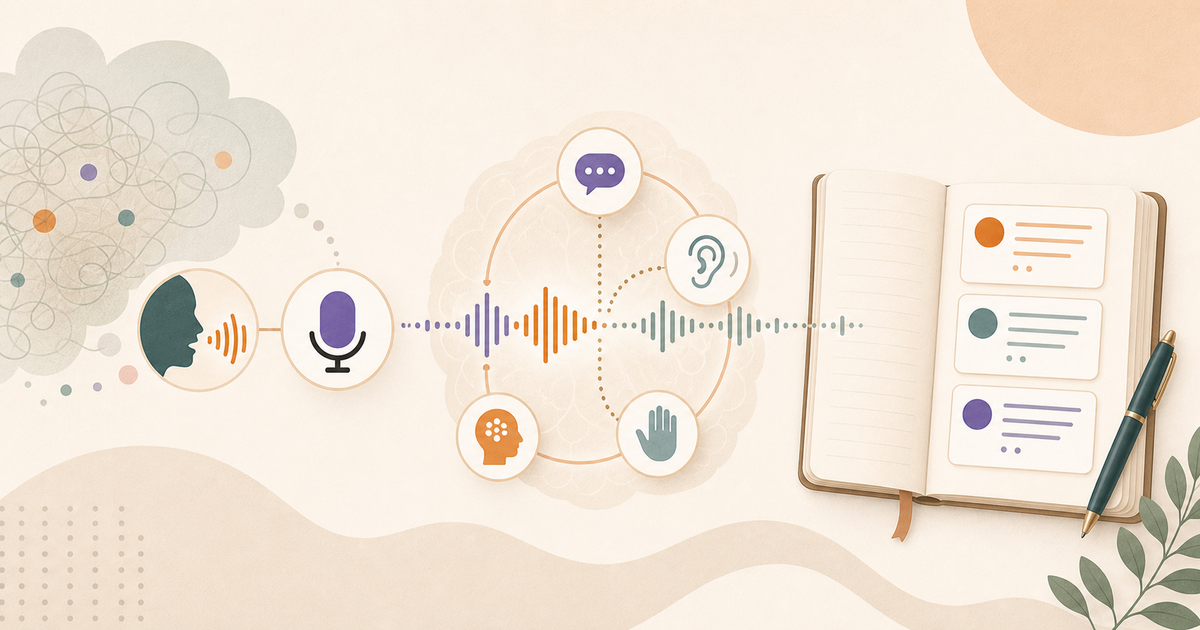
Verbal processing means using speech to work through a thought. You might start explaining why a decision feels difficult and discover, halfway through, that you’re worried about a different part than you expected.
What does verbal processing look like?
Imagine saying, “I don’t want to take on the project because I’m too busy.” As you describe the work, you notice that you’ve handled similar amounts before. You revise the thought: “Actually, I don’t know who can approve it, and I don’t want to keep redoing it.”
You’ve moved from a broad concern to a question you can ask. The conversation helped you develop the thought, even if the other person hasn’t offered advice.
Other examples include explaining a confusing paragraph, rehearsing how to raise a concern, or talking through two options before choosing. Our 21 signs of verbal processing focuses on recognizable situations if you’re wondering when you do this yourself.
Why can speaking help clarify a thought?
Speaking asks you to choose words and put them in an order. As you hear the account, you have something specific to examine: a missing reason, an assumption, or a phrase that doesn’t quite fit.
Research distinguishes different ways of verbalizing. In Fox, Ericsson, and Best’s meta-analysis of 94 studies, simply reporting thoughts aloud didn’t change accuracy overall. Instructions to explain or describe thoughts and actions were associated with better performance than silent conditions. Verbal reporting also tended to increase completion time.
That distinction matters. Speaking more words isn’t automatically helpful; the useful part can be explaining a connection or noticing what you haven’t accounted for. These were task-performance studies, not a test showing that a fixed proportion of people must speak to think.
Research on inner speech also describes varied forms and functions of thinking in words. There isn’t a need to put yourself in one permanent category before trying a different way to reflect.
Can you think aloud and still prefer writing?
Yes. You might talk through a messy first draft, write to compare details, and sit quietly before making a final choice. Writing can help thoughts develop as you write; you don’t have to form every sentence in advance.
Try choosing the medium around the task. A spoken account can be convenient when you want to describe something freely. A written list can keep several alternatives visible at once. A diagram can help when the relationships are spatial. None of those choices disqualifies the others.
If you’re curious about the research behind speaking, why speaking out loud helps you think explores related mechanisms and findings.
Try one unfinished question
Choose an ordinary question that has some uncertainty: “What do I need to ask before agreeing?” or “Which part of that conversation bothered me?” Give yourself a couple of minutes to speak without trying to sound polished.
You don’t have to reach a decision. “I need to ask about the deadline” can be a useful result. If you’re repeating the same account without learning anything, change the question, try writing, or return later.
Think aloud without needing someone on call
When you want a person’s perspective, ask whether they have time and explain what would help: “Could I talk this through before we discuss solutions?” Leave room for their response rather than assuming they only need to listen.
For a private first pass, voice journaling lets you speak on your own. Lound is built for that workflow: talk freely, then reflect after you stop and return to the saved transcript later. You can hear where your account changes without having to turn the first sentence into your final position.
Questions people ask
What is verbal processing?
Verbal processing means using speech to work through an idea, feeling, or decision. You develop or clarify the thought while speaking, rather than only presenting a conclusion you've already reached.
Do verbal processors need another person to listen?
Not always. You can think aloud alone or make a voice journal entry. A listener can contribute questions and perspective, but speaking doesn't require an audience.
Is verbal processing a fixed personality type?
It's useful as a description of how you approach some situations, rather than a fixed category. You can prefer speaking for one task and writing, drawing, or quiet reflection for another.
Can verbal processors also enjoy writing?
Yes. Writing can develop thoughts too. You can speak a first draft, write to organize it, or choose either approach depending on the task.